If you are interested in learning more about astrophysics or gravity, then there are many different outreach activities you can indulge in. I would encourage everyone to get involved!
I regularly help out with lots of different activities, from school workshops to public talks (and, of course, blogging). One of the more interesting projects I have been involved with e-x-p-a-n-d-i-n-g the history of the Universe in 45 min, an performance combining poetry, music and astrophysics in a planetarium dome as part of Stratford Literary Festival. To celebrate the developments in gravitational-wave astronomy, I was part of the team behind the Listening to the Universe exhibition at the Royal Society. Selected talks include at the Universidad Técnica Federico Santa María (11 January 2018), the Lichfield Science & Engineering Society (15 February 2018), Sonoma State University (20 March 2018), Charles University (10 May 2018), Northwestern’s STEM Weekend for Lakota Girls (30 March 2019), and TechFest Aberdeen (6 November 2023). I have enjoyed exploring Scotland to give talks to Inverclyde Skywatchers (15 January 2024), Airdrie Astronomical Association (31 January 2025), and Tweeddale Astronomical Society (24 March 2025), and I am always happy to give a talk to a student society. I was honoured to give a David Elder Lecture at the Glasgow Science Centre Planetarium (17 September 2025).
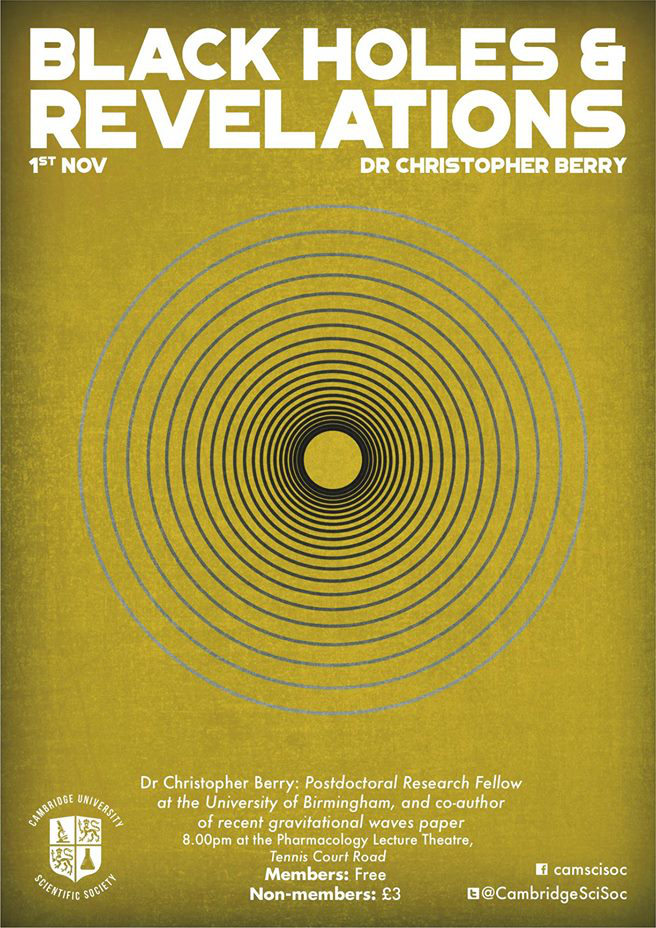
Awesome poster designed for a talk I gave to the University of Cambridge’s Science Society in 2016.
Glasgow
At the Institute for Gravitational Research, we engage in a range of public outreach. We often run workshops with schools, and we have partnered with Tactile Universe to design workshops that are accessible (and fun) for visually impaired students. One of the most fun things I have been involved with is partnering with Science Ceilidh to design some gravitational-wave themed dances. Everyone had a fantastic time giving these a twirl at GR–Amaldi. We organised a range of public events to coincide with this meeting, and I was delighted by the art exhibition inspired by the science of the meeting.
Chicagoland
If you feel like dropping by Evanston, CIERA often hosts public events. The historic Dearborn Observatory is open every Friday. When it is clear, there are some beautiful views through the telescope. The last Friday of every month, there is a CIERA Astronomer Evening at Dearborn as well. Come along to hear a talk by our researchers, and have a friendly chat while waiting to see the telescope. I gave a talk 31 May 2019 which was lots of fun: the questions were great, and I got to see Jupiter (plus its Galilean moons) afterwards! My second time was 31 March 2023 when the questions were just as good, but there was a big storm and no observing.
Birmingham
If you are in the Midlands, then the Astrophysics Space Research Group runs public outreach activities. Particularly exciting are the regular Astronomy in the City events which I developed and ran. The Gravitational Wave Group participates in a wide range of activities, including the Royal Society’s Summer Exhibition (2017); we organised some events to coincide with BritGrav, and recently put together an exhibition for the Thinktank museum. To coincide with the announcement of LIGO’s detection of gravitational waves, I helped to create the video below.
Cambridge
If you are lucky enough to be in Cambridge, the Institute of Astronomy hosts a selection of different outreach activities. There is a public open evening every Wednesday during the winter season, which I can vouch for being excellent. I have previously given talks on solar neutrinos, the Earth’s gravity, detecting gravitational waves in space and the Big Bang.
Online
If you prefer to stay behind a computer, then you can keep up-to-date with science news following me, LIGO, CIERA or the Institute for Gravitational Research on Twitter; feel free to ask any astrophysics questions! For a small burst of procrastination, I made a gravitational-wave wordsearch for the Institute of Astronomy open afternoon. For more serious procrastination, check out our citizen-science project Gravity Spy (I’m currently level 4).
For some listening, I have appeared on a few podcasts
- The Cosmic Companion to discuss intermediate-mass black holes and the discovery of GW190521 (September 2020)
- The Dead Planets Society to plot how to destroy a planet with gravitational waves (August 2023)
- Learning Bayesian Statistics to talk about gravitational-wave data analysis (March 2024)
If you’d like to do some reading, I’d recommend the LIGO Magazine: I’ve contributed a few articles on parameter estimation, understanding our signals, living in the era of public alerts, and working on the third gravitational-wave transient catalogue. I have also a written popular science article on gravitational-wave multimessenger astronomy for Astronomy & Geophysics.
I was delighted to give an interview to the high-school student-run science magazine The Aether. I’ve also been quoted in articles by
- Symmetry on Advanced LIGO (March 2014—I was right about the gamma-ray bursts)
- The Guardian on the detection of GW170104 (June 2017—I was extremely excited at the time) and on testing a model of string theory (July 2017—no signs of breathing modes yet)
- the BBC on our end-of-O2 results (December 2018)
- Gizmodo on looking for hierarchical mergers of black holes (March 2019) and the exciting start of O3 (April 2019)
- Science News on what new things LIGO and Virgo could discover (May 2019); APS News on the future of gravitational-wave astronomy (June 2019)
- National Geographic, The Economist and Space.com on what was then S190814bv and was suspected to be the first high confidence neutron star–black hole detection (August 2019—I thought I was just as enthusiastic, while being cautious that we don’t have final results, in each interview, but I don’t think that’s come across), and Space.com again when we announced it as GW190814 and we’re still not sure if it did come from a neutron star–black hole (June 2020)
- GeekWire pouring cold realism on the possibility of gravitationally lensed gravitational waves (August 2019)
- Scientific American on the gravitational-wave revolution in astronomy (September 2019—four years after our first detection)
- ScienceAlert on the detection of GW190412 (April 2020)
- Nature, National Geographic and Inside Science on the discovery of GW190521 (September 2020)
- Science and IFL Science on the intriguing subsolar mass candidate S251112cm (November 2025—I hope I balanced excitement about potential discovery vs scepticism of the not great detection significance)
 Christopher Berry